Modern process manufacturing depends on reliable automation, accurate process control, and safe plant operation. Whether it is a pharmaceutical production facility, chemical plant, oil and gas facility, power plant, or water treatment system, every process must operate within defined limits.
A small process deviation can affect product quality, production output, equipment, or plant safety. As manufacturing facilities become more complex, traditional standalone control systems can become difficult to manage, expand, and maintain.
This is where Siemens SIMATIC PCS 7 automation provides a practical solution.
SIMATIC PCS 7 is a Distributed Control System (DCS) designed for process industries. It brings together process control, operator monitoring, engineering, alarm management, and plant-wide data handling within an integrated automation environment.
For companies planning new process plants, plant expansion, or automation modernization, understanding the benefits of Siemens PCS 7 can help in selecting the right process control system.
SIMATIC PCS 7 is Siemens’ process control system for industrial automation applications. It is designed to manage complex continuous and batch processes through an integrated system of controllers, engineering tools, operator stations, and plant-level functions.
Unlike a collection of independent automation systems, a DCS provides a coordinated architecture for monitoring and controlling different areas of a plant.
PCS 7 engineering commonly involves:
The platform supports structured engineering through reusable function blocks, templates, and standardized control strategies. This approach can help engineering teams maintain consistency across multiple process units.
Process plants rarely remain unchanged throughout their operating life. Production capacity may increase, new process units may be added, or existing equipment may require upgrades.
A scalable process control system allows automation to grow with the plant.
Siemens PCS 7 can be used in a range of process automation applications, from smaller process units to large, complex installations. The exact capacity depends on the selected system architecture, hardware, licensing, and engineering requirements.
This makes scalability an important consideration for companies planning long-term automation investments.
For example, a chemical manufacturing plant may initially automate one production line and later add additional processing units. A well-planned PCS 7 architecture can support these changes while maintaining a consistent engineering approach.
Chemical, pharmaceutical, petrochemical, and other process plants often operate with high temperatures, pressures, hazardous chemicals, or combustible materials.
Safety Instrumented Systems (SIS) are used where independent safety functions are required to reduce risk. These systems can initiate actions such as emergency shutdowns or placing equipment into a safe state.
Siemens offers safety-related automation solutions that can be integrated with PCS 7 engineering and operator environments, depending on the system architecture and safety requirements.
A properly designed PCS 7-based solution can provide coordination between basic process control and safety-related systems.
Potential benefits include:
Important: Basic process control and safety instrumented functions are not the same thing. Safety functions require appropriate independence, safety lifecycle management, validation, and compliance with applicable standards. Integration does not remove these requirements.
For process plants, the objective is not simply to automate the process, but to control it safely and consistently.
A process control system is only useful when operators can understand what is happening inside the plant.
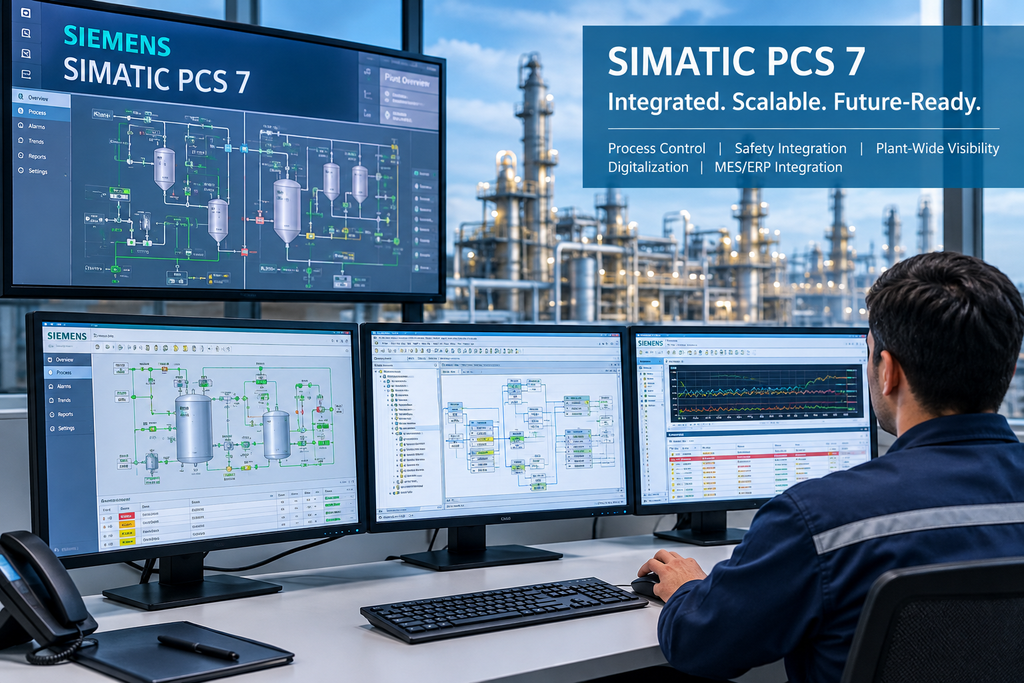
PCS 7 Operator Systems provide process visualization and monitoring capabilities. Engineers can configure graphics, process values, alarms, trends, and operating information to support daily plant operations.
For example, a pharmaceutical production facility may need to monitor:
With centralized operator monitoring, teams can access information from different process areas through a coordinated interface.
PCS 7 engineering may include:
Better visibility helps operators identify abnormal process conditions and respond according to approved operating procedures.
Large process automation projects involve thousands of control elements, instruments, motors, valves, and process sequences.
Developing every control function independently can make projects difficult to maintain and replicate.
PCS 7 supports structured engineering using reusable libraries, templates, and function blocks. Common process functions can be developed in a standardized way and reused where appropriate.
At GEEGEV AUTOMATION, PCS 7 engineering services can include:
A standardized engineering approach can reduce repetitive work, improve consistency, and make future modifications easier to manage.
However, actual engineering savings depend on project complexity, existing libraries, documentation quality, and the scope of modifications.
Process manufacturing includes both continuous and batch production.
Continuous processes may involve:
Batch processes may involve:
Each application has different control requirements.
Continuous processes commonly require stable control loops, interlocks, alarms, and process monitoring. Batch processes may require sequences, recipes, equipment coordination, and defined operating phases.
PCS 7 provides engineering capabilities for these process automation requirements.
A chemical treatment process may include:
A PCS 7 automation system can coordinate these operations through configured process logic, sequential control, operator interfaces, and instrumentation.
The result is a structured control environment that supports repeatable process operation and easier monitoring.
Manufacturing companies increasingly need more than basic automation. They also need information about plant performance, production history, equipment operation, and process conditions.
A modern process control system can provide the data required for these activities.
PCS 7 solutions may include process data archiving, historical trends, and interfaces to higher-level systems, depending on the architecture and licensed components.
For example, a process historian can help engineers review temperature, pressure, flow, and equipment status during a production event.
This can support troubleshooting and root-cause investigations.
Digitalization initiatives may involve:
PCS 7 can form part of a larger digital manufacturing architecture by providing process data and integration capabilities.
However, digitalization is not automatic simply because a plant uses a DCS. Successful implementation also requires suitable data architecture, cybersecurity, software integration, and clear business objectives.
Process automation systems manage the physical production process. MES and ERP systems support different levels of manufacturing and business operations.
MES may be used for production tracking, manufacturing records, and operational coordination. ERP systems support business functions such as planning, inventory, purchasing, and financial management.
A connected automation architecture can help information move between these systems.
Depending on the project design, PCS 7 may interface with higher-level systems through suitable communication and integration solutions.
Examples include:
The specific interface depends on the selected PCS 7 version, system architecture, and MES/ERP platform.
Good integration design is important for reliable data exchange and long-term maintainability.
Many industrial facilities continue to operate legacy automation systems. Over time, older PLCs, DCS hardware, engineering software, and communication components may become difficult to support.
Modernization projects can help plants address:
PCS 7 can be part of a plant modernization strategy where it meets the technical and commercial requirements.
Migration work may include:
A migration should be planned carefully to minimize production interruptions and preserve required process functionality.
At GEEGEV AUTOMATION, we support industrial automation engineering activities related to Siemens PLC and PCS 7 systems, including modifications, troubleshooting, upgrades, and migration-related engineering.
When a plant experiences a process issue, maintenance and automation engineers need accurate information to identify the cause.
PCS 7 provides engineering and operator tools that can support troubleshooting of control logic, process values, alarms, and equipment behavior.
Typical troubleshooting activities include:
A structured control system can make it easier to trace the relationship between field signals, control logic, and operator displays.
The actual troubleshooting time depends on the fault, available documentation, system condition, and engineer experience.
A PCS 7 project involves more than configuring software. It requires an understanding of process requirements, instrumentation, control philosophy, plant operations, and commissioning.
Professional engineering support can be useful during:
GEEGEV AUTOMATION provides Siemens industrial automation engineering support for process and manufacturing industries.
Our services include:
We support engineering activities for industrial applications including chemical, pharmaceutical, manufacturing, water treatment, and other process-related facilities.
SIMATIC PCS 7 is used for distributed process control in industries such as chemicals, pharmaceuticals, oil and gas, power, food and beverage, and water treatment.
PCS 7 is a Distributed Control System (DCS). It uses automation systems, engineering software, operator stations, and other components to manage industrial processes.
PCS 7 is designed primarily for process automation and DCS applications. TIA Portal is Siemens’ engineering framework for products such as SIMATIC S7-1200, S7-1500, and WinCC. The choice depends on the application, control requirements, and system architecture.
CFC stands for Continuous Function Chart. It is used to configure and engineer control functions, signal processing, and process logic in PCS 7.
Yes. PCS 7 is used in process automation applications, including pharmaceutical manufacturing. Project requirements may include batch control, process monitoring, documentation, and validation-related activities.
PCS 7 can be considered for automation upgrades and modernization projects. The suitability depends on the existing system, migration requirements, technical compatibility, and project budget.
Modern process manufacturing requires reliable control, effective operator monitoring, structured engineering, and the ability to adapt to changing production requirements.
Siemens SIMATIC PCS 7 automation provides an integrated platform for process control applications, supporting scalability, process visualization, engineering standardization, data integration, and plant modernization.
For companies operating chemical, pharmaceutical, manufacturing, power, or water treatment facilities, selecting the right DCS is an important long-term decision.
With the right architecture, engineering practices, and technical support, PCS 7 can provide a practical foundation for managing complex industrial processes.